

The CycleThe Trees Speak originated as an eco-song cycle exploring the lives of trees within increasingly fragile urban and ecological environments.
Originally premiered at the Eco-Arts Festival on Governors Island in 2025, the work is being newly arranged for Wild Muse Arts for piano trio and quartet. Acid rain, pollution, disease, drought, council and estate management, vandalism and encroaching housing and road developments all threaten their survival in our urban and suburban world where they have to earn their place to thrive.
In this cycle, we hear life as seen from the point of view of the trees.
I. How to BreatheExamines the everyday life of a tree in a fixed urban park environment and Man identifying himself with its existence, comparing his life, should he become rooted to one spot.
II. The Long GameThe poignant defiant stance of the 150-year-old Sycamore Gap tree near Crag Lough, Hadrian’s Wall in Northumberland, England, known as Robin Hood Tree from the 1991 film, Robin Hood: Prince of Thieves.
III. L’Arbre de La Fontaine des AmoursAn old French tree above a bubbling river that will long outlive us, proudly bears the scars of lovers who have celebrated their transient love by scoring their names into its bark.
IV. A Rare GiftThe idea of a tree bestowing a precious gift of nature, a leaf, to one sheltering underneath its canopy from the intense July heat and summer winds.
V. StumpedA defiant warning to all those chainsaw wielding self-styled ‘tree doctors’ who can’t leave urban trees alone but butcher them into sad lines of battle scarred stumps.
The CollaborationThe Trees Speak emerged from a collaboration between composer Angelique Mouyis and poet David Bottomley. The cycle explores the lives of trees within an increasingly threatened urban and suburban environments.
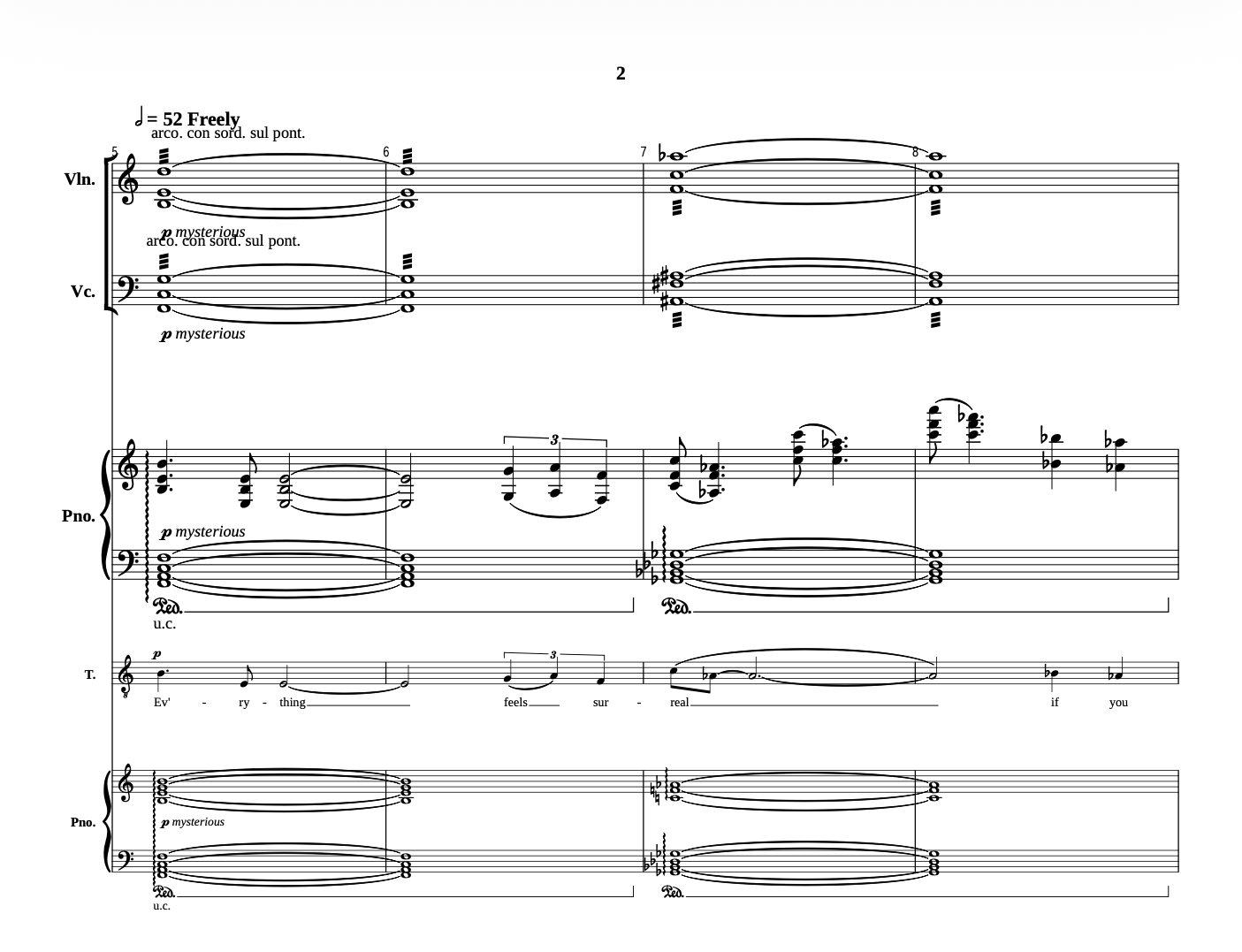
In the chamber arrangement, the vocal part is transferred to violin, cello, and piano — wooden instruments that were once trees. Rather than assigning the singer’s role to a single instrument, Mouyis disperses the melodic lines throughout the ensemble creating “a conversation, like they are all branches of a tree.”
Score excerpt from “How to Breathe” from The Trees Speak for violin, cello, and piano with the original vocal line.
“Everything feels surreal if you look at it long enough.”

Composer Reflections
Selected excerpts from conversations with composer Angelique Mouyis on the creation and arrangement of “How to Breathe” from The Trees Speak.
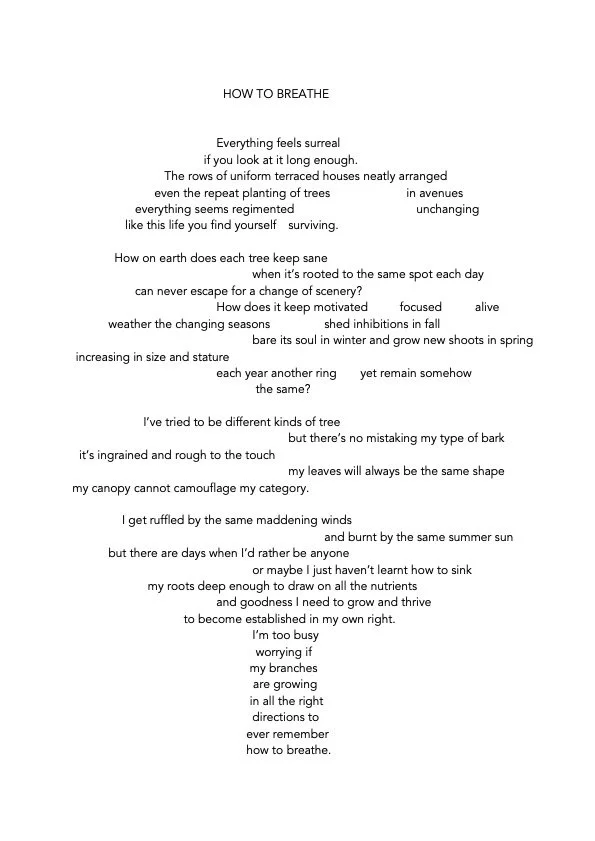
“In “How to Breathe,” the poet poses the question:
How are trees anchored in one place but still manage to grow and flourish? How do they grow so organically, so freely? The poem starts with noticing how regimented the environment is, how all the trees are stuck in the same place, yet how they naturally not only survive all of the elements, but thrive.
The aria itself is all about bringing out the journey of the poet. In Part I, I tried to depict the surreal nature at the beginning - what is surreal is how regimented the world is around the poet.
Part II moves to an internal questioning - about trying to be different, but still being impacted by the same afflictions. The poem ends with the understanding that the poet still hasn’t discovered to be truly himself because he is worrying about what direction he should be moving, so much so that he has forgotten how to breathe naturally.”
“I asked [David] to recite the poetry to me, which helped me find the rhythm when setting them. He was very open to my suggestions in repeating certain words in the musical setting. So the way the words flow, the way they fall off his tongue, guided me in setting the words.
When I listen to the arrangement, I still hear the words in my head. In the arrangement, the voice is given to the trio as a whole. I tried my best to arrange it in a way where the strings were not just the soloists, and the piano was not only in a supportive role. I wanted all of the instruments to give voice to the melody that was originally carried by the singer’s words, and make it more of a conversation, like they are all branches of a tree.”
“I love trees — I am in awe of these beings, and try to capture this awe musically, as well as aspects such as falling leaves, the sound of wind through the leaves, their height, the animal life that they carry. Of course, humans would not exist without them, so that circle of life is a great inspiration.”
About the Composer & Poet
-
Angelique Mouyis is a South African-born, Greek-Cypriot composer based in the New York tri-state area. Her work bridges cultures and genres, blending her South African roots, Greek heritage, and American experiences into a distinctive musical voice. Her compositions have been performed internationally, with highlights including The Trees Speak (poetry by David Bottomley), premiered at the Eco-Arts Festival on Governor’s Island in 2025; A Song to Heal, premiered by the Western Colorado Concert Choir in 2025; and operas Family (with Gabe Caruso, NYU/American Opera Project, 2022) and Bessie: The Blue-Eyed Xhosa (with Mkhululi Mabija, Cape Town Opera/UCT, 2015). Angelique holds a Ph.D. in Music Composition from Rutgers University, an MFA in Musical Theatre Writing from NYU's Tisch School of the Arts, and a Master’s in Music Composition from Wits University. She is the author of Mikis Theodorakis: Finding Greece in His Music and recipient of SAMRO and Ernest Oppenheimer scholarships.
-
David Bottomley is an award-winning poet and librettist who works nationally and internationally with composers in song settings and operas. A 2023 MA graduate in Opera Making and Writing at Guildhall School of Music & Drama for which he was commissioned to write the libretto for his eco-opera Lanternfish. He was commissioned to write HOLME with composer, Ben Pease Barton for the inaugural Jane Manning- Anthony Payne Award for the Guildhall Symphony Orchestra and The World Turns, a choral piece with composer, Emily Hazrati for St Martin’s Voices.
The opening movement of The Trees Speak, “How to Breathe,” will premiere in a newly arranged version for piano trio as part of Seed in May 2026.
The remaining movements of The Trees Speak will unfold later in the season during Flight in October 2026, in a chamber setting for flute, violin, cello, and piano.